





Basic Rules
Basketball is a ball game in which two teams of five players each compete to score Points by putting the ball into the opponent's basket.
The team with the most Points when the time is up will be the winner.
Number of participants in Games
Each team has five members on the court, and players can make as many substitutions as they like during Games, with no limit on the number or frequency of substitutions.
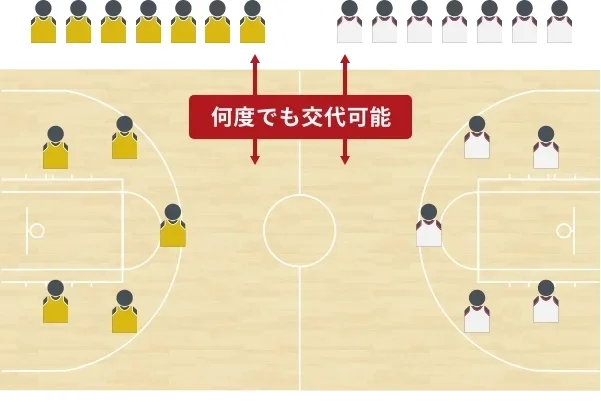
Each team is Toyotagoseikinen Gymnasium to 10 to 14 players per Games.
From the 2022-23 SEASON, Youth development special allocation will be put into place, allowing up to 14 Toyotagoseikinen Gymnasium the bench.
Games duration
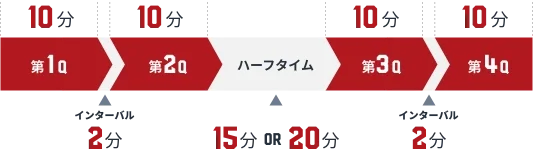
In B.LEAGUE, Games are played in four 10-minute quarters (Q). There are two-minute intervals (breaks) between the 1st and 2nd quarters, and between the 3rd and 4th quarters, and a 15-20 minute halftime between the 2nd and 3rd quarters. The team with the most Points at the end of the 4th quarter wins. In the event of Draws, a five-minute overtime period will be played. Overtime periods will be repeated until a winner is decided.
Timeout
Timeouts can be taken as Timeout time twice in the first and second quarters of the first half, three times in the third and fourth quarters of the second half, and once during each overtime period.
position
In basketball, all players can move freely around the court, but they are assigned five positions that represent their characteristics. There can be more than two players of the same position in Games. The five players on the court can be freely positioned according to strategy and tactics.
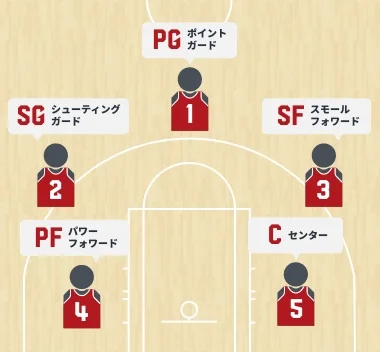
1 PG (Point Guard)
They act as the team leader, deciding and issuing instructions to the five players on the court. They keep track of the overall movement and make calm decisions to lead the team on both offense and defense.
2 SG (Shooting Guard)
This position assists the point guard and actively aims for three-point shots from long distances. It tends to be filled by players with high outside Points ability.
3 SF (Small Forward)
This is an ace position that requires players to be able to perform over a wide area, not just take long-distance three-point shots, but also dribble towards the goal.
4 PF (Power Forward)
This position is primarily responsible for Points in the mid-range or under the basket. They are involved in Points and rebounding by putting their bodies on the line near the basket.
5 C (Center)
There are many tall players, and they play the role of the backbone of the team. They defend the goal by Block and rebounding. It is a position that requires a lot of physical ability as there is a lot of contact with the opponent.
Shoot
Points are scored by passing the ball through the ring on the team's side from above. The shot must be made in an arching motion to hit the ring, which is 305cm above the floor.
Field Goals (FG)
Goal from outside the 3-point line: 3 points
Goals from inside the 3-point line: 2 points
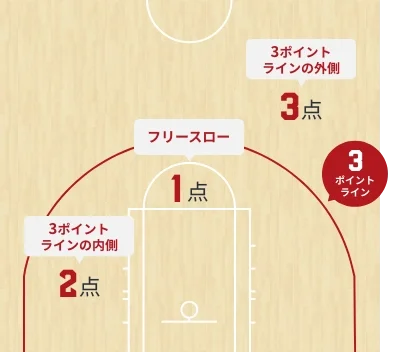
Free Throws (FT)
1 Free Throws: Technical foul, etc.
2 Free Throws: Foul on a 2-point shot, etc.
3 Free Throws: Foul on a 3-point shot
Free Throws goals: 1 point
Basket Count
If you are fouled but the shot goes in, you get a Points and can also take one Free Throws.
In the case of 3 point shooting shot basket count, one Free Throws is also counted.
Buzzer Beater
A shot taken just before the game clock or 24-second clock reaches zero and goes through the goal after the clock reaches zero in the air. This shot will count as Points.
Foul
This refers to unfair physical contact with players on the opposing team and unsportsmanlike conduct.
This is penalized when the defending team impedes the opponent's movements by pushing, kicking, hitting, holding back, or other means.
There are also fouls where the offensive player charges into the defender standing in their way.
Personal fouls (5 fouls)
A player cannot commit five fouls in a single Games. After the fifth foul, the player must leave the game and be replaced by another bench player. After being ejected, the player cannot play in that game again.
Team Foul
After a team's fifth accumulated foul in each quarter, the opposing team will be awarded two Free Throws for each foul.
Disruptive foul
While not reaching the level of a flagrant foul, it is judged as an unfair contact with an opposing player that tactically interrupts play, disrupts the flow of the game, and disadvantages the opposing team. It does not accumulate to result in disqualification or expulsion during Games.
Fragrant foul
This includes contact that violates the spirit of sportsmanship and fair play, as well as dangerous fouls. Two flagrant fouls, or one flagrant foul and one Category 1 Technical foul, will result in disqualification and ejection from Games, and the player will not be allowed to remain on the bench.
Technical foul
[Technical foul Category 1]
This primarily applies to actions or words deemed disrespectful towards the opposing team, referees, or other related parties, as well as fake fouls. These fouls accumulate during Games and can lead to disqualification or expulsion. Two accumulated fouls (including flagrant fouls) result in disqualification or expulsion.
[Technical foul Category 2]
This includes actions such as delaying the game and grabbing the ring and putting weight on it. These actions will not be accumulated and lead to disqualification or expulsion during Games.
Violation
Any violation other than a foul against the rules is called a violation. When a violation occurs, the possession of the ball is transferred to the opposing team. The ball is Law in from the side or end line where the violation occurred within the set number of seconds to resume the game.
24 Second Rule
When on offense, a team must shoot within 24 seconds. If the ball touches the hoop within 24 seconds, the 24-second countdown is reset. If the offensive team has the ball, it is reset to 14 seconds, and if the defensive team has the ball, it is reset to 24 seconds. At Games venues, there is often a 24-second timer above the goal.
The 8-Second Rule
Once the offensive team has taken possession of the ball, they must carry it into their front court (over the center line to the opposing team's goal line) within eight seconds.
The Three Second Rule
During an attack, you may not remain in the restricted area under the opposing team's goal for more than three seconds.
Five Second Rule
When taking Law-in or Free Throws from outside the court, the ball must be played within 5 seconds of receiving it from the referee.
Once you receive the ball on the court, you must either pass, dribble or shoot within five seconds.
Traveling
You cannot take more than three steps with the ball in hand without dribbling. Traveling is also when your pivot foot shifts or moves while pivoting.
Out of Bounds
When the ball goes out of bounds, the game is restarted with Law-in from the nearest line (side or end).
Double Dribble
This is when you stop dribbling and then start dribbling again.
Backcourt Violation
The act of bringing the ball to the frontcourt and then returning it to the backcourt (across the center line to the team's goal line).
Interference
Once the ball is in the air after shooting, you may not touch the net, backboard, or ring.
Goaltending
Once the ball is shot, it must not be touched when it is above the hoop and is falling after reaching its highest point.
Kickball
It is intentionally kicking or stopping the ball with your foot. If it happens accidentally (if the referee judges it was not intentional), it is not a violation.


About Cookies
This site uses cookies that are essential for the operation of our services. We may also use cookies to analyze usage patterns and deliver advertisements.
By clicking "Agree," you consent to the use of all these cookies.
If you wish to refuse, please select "Disagree" (however, cookies necessary for basic functions will still be used).
Cookie details